- Home
- Intelligence
- Interim Management & Advisory
- BAFA-Listed SME Advisory
- Media and Ventures
- Products and Services
- Contact

Masters Group
System intelligence for decision advantageFrom insight to execution. From complexity to measurable value.
Masters Group helps leaders understand complex systems, make better decisions and execute transformation with measurable value.The platform combines proprietary intelligence, executive advisory, media reach, publishing authority and selected execution support across strategy, financial systems, AI value realisation, institutional change, transformation economics and sector disruption.
Through Masters Group Intelligence, we provide executive briefings, private briefings, sector dossiers, strategic intelligence notes, System Signals, Executive Intelligence Calls and transformation-support services for leaders navigating capital pressure, regulation, AI-enabled change, operating-model redesign and strategic control shifts.
Request an Executive Briefing | Explore Latest Intelligence | Subscribe to System Signals | Request Execution Support | Request Advisory Service
AI Value Realisation & Transformation Economics
AI adoption is no longer the main challenge.
The harder question is whether AI creates measurable business value.Masters Group supports leaders from AI value diagnosis through operating-model design, execution planning, implementation support, KPI tracking and value realisation.From insight to execution: we help leadership teams define the value case, build the operating model, track the KPIs, govern the work and move from pilot activity to measurable outcomes.
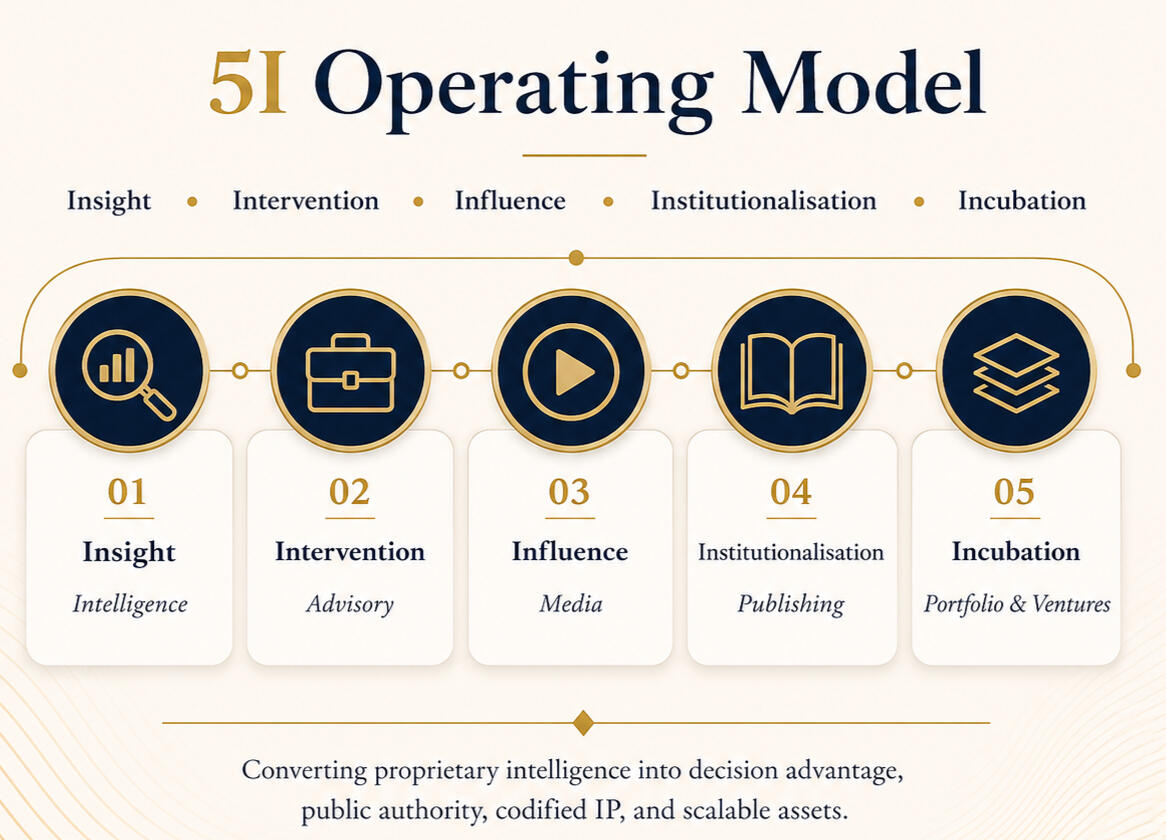
5I OPERATING MODEL - A platform for intelligence, advisory, media, publishing, and venture development
Masters Group operates as a five-engine platform built around System Decision Intelligence. We develop proprietary analysis, executive briefings, media assets, publications, production capabilities, and selected portfolio assets that help leaders and serious audiences understand complex systems, transformation pressure, and value migration across business, finance, technology, institutions, and society.The platform connects Intelligence, Advisory, Media, Publishing, and Portfolio & Ventures through the Masters Group 5I Operating Model: Insight, Intervention, Influence, Institutionalisation, and Incubation.
| 5I OPERATING MODEL | value proposition |
|---|---|
| Insight | Produces proprietary analysis, frameworks, diagnostics, sector dossiers and system-level understanding. |
| Intervention | Converts insight into executive briefings, client consulting, workshops, transformation support, decision action and strategic projects. |
| Influence | Translates selected ideas and creative work into public-facing or client-facing media formats. |
| Institutionalisation | Codifies knowledge and creative assets into durable intellectual property and formal releases. |
| Incubation | Develops selected platforms, channels, digital products, production assets, and future business assets. |
Client Profile and Regional Coverage
Masters Group advisory and intelligence work supports executives, investors, boards, founders, public sector and regulatory bodies, transformation leaders, consulting teams, and senior professionals navigating strategic, financial, regulatory, operating-model, technology, and market-structure change.Recent advisory and intelligence work has supported discussions with global consulting firms, corporates, investment banks, specialist advisory platforms, financial institutions, investors, and senior decision-makers. Client identities, platforms, and mandate-specific details are not disclosed.Regional coverage over the last 12 months has included Europe, including Switzerland and the UK, as well as Asia, the United States, the Middle East, and Africa.We disclose patterns, not client identities.
BAFA-listed consulting company
Masters Group is listed as a consulting company for the BAFA programme “Förderung von Unternehmensberatungen für KMU”. Eligible SMEs in Germany may be able to apply for subsidised advisory support.
Use link below to Read about Masters Group combined Terms of Service and Privacy Policy
Latest Flagship Intelligence
Latest Dossier:Automotive as a Capital Conversion System
Release: August 2026
Residual-value and finance exposure | Software and battery relevance risk | Supplier competitiveness | Investor and IC implications
The forthcoming Masters Group Intelligence Automotive Dossier examines automotive as far more than a vehicle market or financing cycle. It treats automotive as a capital conversion system: a structure through which industrial capability, consumer desire, technology, energy, infrastructure, regulation and financial architecture are converted into revenue, collateral, residual value, market power and institutional exposure.The dossier follows how automotive systems create and protect value across origination, production, ownership, financing, resale, infrastructure dependence, software integration, fleet economics, policy pressure and global competition. It asks where capital is being created, where it is being trapped, where it is being transferred and where legacy assumptions may no longer hold.Automotive Equity Timing is one public signal from the wider thesis. The full dossier goes beyond timing and finance to examine the deeper system: how mobility becomes a financial, industrial, technological and institutional mechanism.Expected outcome: senior leaders, investors and advisors should be able to read automotive exposure not only through sales, margins or credit performance, but through the broader conversion logic that links assets, capital, infrastructure, behaviour and control.For private executive discussion on the forthcoming Automotive Dossier or its relevance to a specific institution, portfolio, market or strategic decision, contact Masters Group Intelligence Briefings at [email protected]
Masters Group Intelligence
Masters Group Intelligence (MGI) is a decision-grade intelligence and advisory platform for leaders navigating financial-system reconfiguration, AI-enabled transformation, capital pressure, institutional risk, regulation, industrial transition, and strategic control shifts.MGI provides decision-grade intelligence on financial systems, market structure, transformation, AI, regulation, capital pressure, institutional risk, and sector change. We help executives, investors, boards, founders, and transformation leaders understand what is changing, why it is changing, where pressure is building, and what strategic decisions may be required.
System Decision Intelligence | Proprietary diagnostic frameworks | Executive and boardroom briefings | Sector dossiers | IC-ready strategic intelligence notesProprietary intelligence, diagnostics, dossiers, and decision tools.
Latest Intelligence
The infrastructure layer is becoming a more material source of competitive and risk differentiation in finance.
Watchpoints ahead: whether non-bank access to core payment systems changes transaction economics; whether T+1 readiness exposes manual and fragmented post-trade processes; whether tokenised assets gain liquidity as settlement and collateral treatment integrate; and whether private-market growth creates new funding, liquidity or operational transmission channels into banks and insurers.Sequencing matters and is not synchronised: the US has already moved to T+1; Europe, the UK and Switzerland are preparing for the 2027 window; Pontes remains in testing rather than production; tokenisation remains anchored to settlement design and trust architecture; private credit is large enough to matter but is not itself evidence of instability.This signal describes architecture moving into implementation — not a finished end-state.
20 Aug. 2026
Five Results-Season Tests to Carry into H2 2026
Q2/H1 results have strengthened the evidence base, but the more useful work begins after the headline releases. Management teams, boards and allocators should now test whether current financial-sector performance is becoming more durable.
• Earnings quality: separate structural operating improvement from rates, markets, claims experience and one-offs.
• Transformation economics: test whether technology and operating-model investment is producing measurable cost, productivity, service, risk or revenue outcomes.
• Client control: watch deposits, assets, mandates, transaction flows, retention and distribution access together rather than in isolation.
• Risk-adjusted growth: test whether growth is entering businesses with attractive margins after capital, claims and volatility are considered.
• Capital optionality: assess not only how much capital exists, but what strategic choices it can fund without weakening resilience.
• Allocator lens: ask whether the market has already priced durability, or whether reported strength remains discounted as cyclical, rate-supported or claims-supported.The H2 question is not whether Q2 was strong. It is whether the operating model can reproduce the economics under less supportive conditions.
13 Aug. 2026
Bank Earnings Watchpoint: Profitability Is Visible; Optionality Is Harder to Read
Recent bank results show that profitability is still present across many large institutions. But the more decision-relevant question is whether banks have enough optionality if the operating environment changes.
Profitability is visible through net interest income, fee income, trading conditions, cost programmes and capital ratios.
Optionality is harder to read. It sits inside rate sensitivity, credit migration, cost-income durability, liquidity flexibility, capital mobility, AI execution, operational resilience and management capacity.
For executive teams, this means the banking results season should be read less as a profit snapshot and more as a balance-sheet flexibility test.
Watchpoints for the next 6-18 months:
- How much NII is structural versus rate-cycle dependent?
- Are risk costs normalising gradually or lagging the real credit cycle?
- Are NPL and Stage 2 signals influencing lending appetite?
- Are cost programmes improving the operating model or mainly delaying expense?
- Is AI producing measurable operating leverage after cost, governance and cyber controls?
- Is capital mobile enough to support growth, distributions and stress absorption?
The public signal: profits matter, but optionality determines resilience.
Insurer Results Watchpoint: Earnings Quality Is Becoming the Real SignalQ1 2026 insurance results are moving from growth narratives to capital quality. In the current results rotation, headline strength is visible across P&C, Life & Health and reinsurance: underwriting discipline remains strong, solvency is resilient, investment income is supportive, and several large players are reporting attractive combined ratios or operating performance.
For insurers, reinsurers and brokers, this makes Q1 2026 a signal about quality, not just strength. A low large-loss quarter, prior pricing momentum or improved reinvestment yield can make results look cleaner than the underlying forward economics. The leadership test is whether management can explain what is structural, what is cyclical, what reflects loss timing, and what depends on assumptions that have not yet been tested.
Automotive Transition WatchpointFrom EV Growth to Financing PressureRecent automotive signals suggest that the transition should not be read only through adoption rates, production targets or technology headlines. The deeper question is whether financing structures, used-vehicle values, leasing assumptions and consumer replacement optionality remain aligned as vehicle technology changes faster than asset economics.
Current Intelligence Themes
Current intelligence themes include AI value realisation, private credit transparency, insurance distribution economics, claims operations, insurer ALM and investment governance, banking capital and liquidity, custody and collateral services, wealth-platform distribution, automotive finance timing risk, property-risk data, CFO transformation, investment governance, regulatory architecture, and financial-system reconfiguration.
System Signals
System Signals by Masters Group Intelligence
A periodic intelligence note on system risk, value migration, transformation pressure, and executive decision advantage.
The Signal | Why It Matters | System Transmission | Executive Question | Related MG / LU Asset
System Signal 18: Transformation Claims Are Becoming
Measurable — or Exposed
BOARDROOM QUESTION
Can we reconcile the transformation target to a credible baseline, gross benefit, cost-to-achieve, reinvestment and leakage — and then show what has actually reached the P&L, cash flow, capital position or operating capability?The thesis
Transformation used to be easy to describe and difficult to verify. Launches, migrations, use cases and restructuring actions remain relevant indicators, but on their own they are increasingly insufficient.
A growing number of organisations now disclose annualised savings, cost-to-achieve, process productivity, margin uplift, restructuring cash outflows and operating-efficiency effects. This supports a sharper analytical question for boards and investors: what part of the claimed transformation has actually converted into economics?
A September 2026 Deloitte survey of 500 senior leaders (sample composition not further disclosed in the source used here) indicates the gap: 96% of respondents said their organisations were pursuing, had completed, or were planning cost transformation; 14% said they had fully captured the value targeted by their highest-priority initiative in the prior year. The survey also suggests that most organisations expect meaningful investment to achieve savings, while its findings point directionally — rather than through a single quantified ratio — to fewer organisations explicitly accounting for value leakage when setting targets. [S1]
This does not suggest transformation value is simple to measure. It makes evidence quality a more explicit management challenge.The same word “transformation” now produces different evidence
The six examples below were selected from Q2 2026 reporting across banking, insurance and automotive to illustrate a range of evidence levels; they are not a representative sample or a comparable scorecard.
System Signal 12: Finance’s Control Points Are Shifting Below the Headline Layer
Payments, settlement, collateral, tokenisation and non-bank intermediation are changing how the financial system’s control architecture works.
MGI’s current interpretation: the financial system is not simply digitising at the surface. Its control architecture — access, settlement, collateral, liquidity, operational resilience and intermediation — is being restructured, based on the developments below from ECB, ESMA, FSB, BIS, Federal Reserve, SEC and UK/FCA sources.
Much of this change sits below bank earnings, product launches and market headlines. It is occurring in the infrastructure that moves money, settles securities, mobilises collateral, connects tokenised assets to central-bank money and links banks with non-bank intermediaries.
This is not a Europe-only story, although Europe currently provides the densest evidence base: TIPS, TARGET access, ECMS, Pontes and T+1 preparation. North America has already moved securities settlement to T+1; the UK is aligning with the 2027 transition; US instant-payment infrastructure is scaling through FedNow; and BIS work on tokenisation and Project Agorá is global in scope. Jurisdictions are moving on different timelines — this is directional convergence, not synchronised implementation.
Infrastructure is not neutral. It determines who can access settlement, how quickly liquidity moves, which assets can be mobilised, where operational dependencies sit, who controls the client interface and which institutions can capture transaction economics.
This is not displacement of the existing system. A faster, more continuous and more programmable architecture is being built around it, while non-bank intermediation increases the number of channels through which liquidity and risk can travel.The signal in one line
Finance’s control points are moving from product-level competition to infrastructure-level dependence: payments, settlement, collateral, liquidity, data, operational resilience and non-bank transmission.
Global reference frame
1. Payment access is widening as settlement becomes more continuous
TARGET Instant Payment Settlement (TIPS) settles instant payments in central-bank money around the clock. ECB data show TIPS transaction volumes rose 82.5% in full-year 2025 versus full-year 2024, from 1.35 billion to 2.47 billion transactions — growth that should be read against 2024’s smaller base as instant payments scaled. Since October 2025, qualifying non-bank payment service providers can access TARGET Services directly, including T2 and TIPS. This indicates a change beyond payment speed: broader access and 24/7 settlement can alter liquidity economics, transaction-banking value and the importance of controlling the primary payment relationship. FedNow provides a comparable US reference point for continuous payment rails already in operation.
2. Collateral is becoming a more integrated operating layer
The Eurosystem Collateral Management System (ECMS) replaced fragmented national systems with a common platform. In 2025, the average daily stock of collateral mobilised through ECMS was approximately EUR1.58 trillion. The ECB has also begun accepting certain DLT-based marketable assets as eligible Eurosystem collateral, subject to existing eligibility and settlement requirements. Collateral eligibility and mobility affect more than operational efficiency: they influence access to central-bank liquidity, intraday funding and balance-sheet flexibility under stress.
3. Tokenisation is connecting to core settlement, not building entirely outside it
The relevant question is no longer traditional finance versus digital assets, but how tokenised assets, regulated money and existing market infrastructure connect. The Eurosystem’s Pontes initiative is designed to link market DLT platforms to TARGET Services for settlement in central-bank money; as of this evidence cut-off, user testing is under way ahead of a planned initial launch — Pontes has not reached production go-live. BIS’s 2026 work frames tokenisation as innovation within a two-tier monetary system anchored in central-bank money; Project Agorá explores tokenised central-bank reserves and commercial-bank deposits for wholesale cross-border settlement. This is not evidence that banks or central-bank money are being displaced: much of the current architecture is explicitly designed to preserve central-bank money as the settlement anchor. Interoperability, legal treatment and governance remain open constraints on scale.
4. Post-trade compression is a 2026 operating issue ahead of the 2027 deadline
The EU moves to T+1 securities settlement on 11 October 2027, but ESMA has named 2026 a key preparation year, with a first deadline of 7 December 2026 for allocation and confirmation improvements. The UK is aligning with the same 2027 date; the US implemented T+1 in May 2024. A shorter settlement cycle compresses the time available for matching, funding, FX execution, securities lending and exception management. It can lower counterparty exposure and accelerate capital recycling, while raising the operational cost of unresolved data and process gaps.
5. Intermediation is expanding beyond banks, with risk transmission still connected to them
The Financial Stability Board estimates global private credit at roughly USD1.5–2.0 trillion, with deepening interconnections to banks, insurers and private-equity firms. The ECB’s Financial Stability Review highlights liquidity, leverage and opacity risks in non-bank finance, including potential spillback into banks and public markets. Institutional boundaries matter less than transmission channels: a bank may not hold an underlying private asset but can still be exposed through funding, deposits, derivatives or credit lines.
6. Operational resilience is becoming part of financial economics
As settlement and payment rails become more integrated and technology-dependent, DORA’s harmonised incident-reporting regime and oversight of critical ICT providers reflect the same structural shift: understanding control now requires visibility into infrastructure and third-party dependencies, not only balance-sheet exposure.What this means for management
A useful management test: can leadership identify which external and internal rails control settlement, liquidity, collateral, data, client access and operational continuity — and the economics if any of those control points move?
| Institution | Selected reported fact | What it supports |
|---|---|---|
| Board / CEO office | Where could rail dependence alter economics, resilience or client control? | Prioritise the rails that are financially material and externally dependent. |
| CFO / Treasurer | Which payment, collateral, funding or settlement dependencies affect liquidity under stress? | Convert infrastructure change into liquidity and capital planning. |
| COO / Technology | Where do fragmented data, manual exceptions or third-party dependencies create implementation risk? | Build a readiness plan for T+1, instant settlement, DLT interoperability and resilience requirements. |
| Strategy / Business heads | Which client-access or transaction rails are becoming contestable? | Assess whether control points shift margin, relationship depth or distribution economics. |
The executive question
Which payment, settlement, collateral, liquidity, data and client-access rails does the institution depend on, which does it control, and where could a change in those control points alter economics or resilience?Masters Group Intelligence is preparing a private Financial Infrastructure & Control Architecture briefing to map these dependencies into operating, liquidity and strategic decisions. This signal is a strategic and financial interpretation of public information; it is not legal, regulatory or investment advice.
System Signal 11: Q2 Results Suggest a Widening Divide in Financial-Sector Operating Leverage — Operating Leverage, Client Control and Capital Optionality
Q2 and first-half 2026 results indicate a divide that matters more than headline profit growth: whether institutions are converting transformation investment, client relationships, risk selection and capital strength into operating leverage that would persist under less supportive conditions.
This reading covers eleven European and UK-listed banks and insurers that had reported Q2/H1 2026 results as of the 12 August 2026 evidence cut-off: Deutsche Bank, UBS, Standard Chartered, UniCredit, HSBC, Allianz, AXA, Zurich, Generali, Munich Re and Swiss Re.
Reported profitability across the sample is strong, in several cases record. That strength is real, but it is also consistent with a shared macro tailwind: supportive markets, still-valuable rate dynamics, benign catastrophe and credit experience, and strong asset flows across much of the sample.The distinction this signal draws is therefore not a ranking. It is a durability test: which parts of the earnings base appear supported by operating-model change, client control, risk selection, cost discipline and capital allocation — and which parts may weaken when conditions normalise.THE SIGNAL
MGI’s current read is that Q2/H1 results suggest a widening divide in financial-sector operating leverage. The test is not simply who earned more, but who is building economics that can be repeated through operating leverage, client control, risk selection and capital optionality.Selected results facts
The table is not a ranking and does not imply comparability across accounting bases or business mixes. It shows why the interpretation is grounded in the current results cycle rather than generic commentary. Metrics and APMs are company-defined unless otherwise stated; figures may be rounded and are indicative rather than directly additive or comparable.
| Institution | Selected reported fact | What it supports | Audit caveat |
|---|---|---|---|
| Deutsche Bank | Record Q2 post-tax profit of EUR 1.9bn; EUR 0.2bn Q2 operating efficiencies; EUR 34bn net inflows. | Profit strength, operating-efficiency evidence, client-flow evidence. | AI is management commentary, not causal proof. |
| UBS | Q2 net profit USD 2.8bn; 8pp positive operating leverage; USD 36bn Global Wealth Management net new assets. | Integration economics and client-control evidence. | Use UBS/APM definitions; do not rank against peers. |
| Standard Chartered | Record H1 PBT USD 4.8bn; Wealth Solutions +43% in Q2; CET1 14.2%; USD 1bn buyback. | Wealth growth, capital optionality and return capacity. | Preserve excluding/notable basis for expense comments. |
| UniCredit | Adjusted H1 net profit EUR 6.1bn; adjusted RoTE around 24%; management cited technology and AI investment. | Efficiency frontier and investment capacity. | Adjusted basis must be labelled. |
| HSBC | Interim results include wealth-fee growth, technology investment, ECL overlays and deposit growth; 2Q26 presentation/data pack provide the main source base. | Client control plus risk overlay. | Preserve constant-currency and ex-notable-item definitions. |
| Allianz | Q2 operating profit EUR 4.9bn; H1 operating profit EUR 9.4bn; Solvency II 225%; AM H1 net inflows EUR 84bn. | Multi-engine earnings, capital and asset gathering. | Core/net income affected by items outside operating profit. |
| AXA | H1 underlying EPS/earnings and management commentary on technology/AI efficiency gains. | Efficiency and diversified earnings. | AI linkage is qualitative unless quantified. |
| Zurich | H1 BOP around USD 4.8bn; Core ROE 27.1%; SST 266%; growth in preferred areas. | Risk selection and capital strength. | Life and markets can support BOP; do not over-structuralise. |
| Generali | H1 operating result EUR 4.5bn; Life NBV EUR 1.89bn; Solvency Ratio 216%. | Product mix, fee engines and capital strength. | P&C combined ratio and Nat Cat movements remain caveats. |
| Munich Re | H1 result around EUR 3.9bn; very low major-loss expenditure and strong investment result flagged. | Counter-case and underwriting discipline. | Environmental support must remain in public copy. |
| Swiss Re | H1 net income USD 2.8bn; low large Nat Cats and favourable mortality supported results. | Counter-case and diversification. | Do not treat benign loss experience as structural. |
1. Strong profits are the starting point, not the conclusion
The results season contains multiple record or near-record outcomes. Deutsche Bank reported record Q2 post-tax profit of EUR 1.9bn. UBS reported Q2 net profit of USD 2.8bn. Standard Chartered reported record first-half profit before tax of USD 4.8bn. Allianz reported record Q2 operating profit of EUR 4.9bn; Zurich, Generali, Munich Re and Swiss Re also reported strong result indicators across H1. These figures establish earnings strength. They do not, on their own, establish earnings durability.
2. Operating leverage is becoming more observable, but not yet universally proven
Several institutions now discuss transformation in economic rather than purely technological terms. Deutsche Bank reported Q2 operating efficiencies; UBS reported positive operating leverage; HSBC described simplification savings; AXA discussed technology and AI-enabled efficiency progress. These are management-reported indicators, not independent proof that technology or AI caused the earnings outcome. The defensible conclusion is narrower: operating-model change and cost discipline are increasingly being linked to measurable efficiency and productivity outcomes.
3. Client control is part of the earnings mix
Net inflows, deposits, mandates, wealth activity and transaction relationships matter because they can create multiple earnings pools around the same client. UBS, Deutsche Bank, Standard Chartered, HSBC and Allianz all disclosed client-flow or wealth-related indicators that support this lens. The caveat is important: flows do not automatically prove pricing power or profitability without margin, yield and retention evidence.
4. Capital strength creates optionality, but also requires interpretation
Strong capital can fund growth, absorb volatility, support transformation, permit selected inorganic opportunities or return capital. But buybacks do not automatically prove strategic strength; they can also reflect disciplined capital return where reinvestment opportunities are limited. The relevant question is what strategic choices current capital can fund without weakening resilience.
5. Risk selection is as important as growth
Insurance and reinsurance results make the portfolio-quality question particularly visible. Zurich, AXA, Munich Re and Generali all provide examples where underwriting discipline, product mix, preferred segments, renewal pricing or business selection affect the interpretation of growth. The broader management point is that revenue, premium or asset growth should be read against capital consumption, claims experience, volatility and risk-adjusted economics.
6. The counter-case: a shared tailwind may be doing more work than the thesis
The leading alternative explanation is that the apparent divide is partly the result of common support across the sample rather than purely structural change. Munich Re and Swiss Re explicitly benefited from low large-loss or favourable claims/mortality experience. Strong markets supported wealth and asset-management flows. Rate dynamics and limited visible credit stress remain relevant. Directionally, the environmental support looks material rather than marginal; the public sources do not permit a clean aggregate isolation of how much of H1 profit growth is structural versus cyclical. This is why the signal remains a stress test, not a league table.
7. Five tests to carry into H2
| Test | Board / allocator question |
|---|---|
| Earnings quality | How much of current profit is structural versus market-, rate-, claims- or one-off-dependent? |
| Operating leverage | Are technology and operating-model investments producing measurable, quantified cost or productivity outcomes — not only management commentary? |
| Client control | Are deposits, assets, mandates, transactions and distribution relationships deepening, and at what margin? |
| Risk-adjusted growth | Is growth entering businesses with stronger economics after capital, claims and volatility are considered? |
| Capital optionality | What strategic choices can current capital fund without weakening resilience — and is capital return substituting for a lack of reinvestment opportunity? |
| Valuation / allocator read-through | Has the market already re-rated the earnings improvement, or is the valuation still discounting cyclicality, regulatory drag or weak reinvestment options? |
THE EXECUTIVE QUESTION
What portion of current earnings would remain if rates, markets, claims and credit conditions normalised — and what portion depends on conditions that are unlikely to persist?
Masters Group Intelligence is using the current results cycle as an evidence layer across its banking, insurance, AI operating-leverage and financial-system work. The private layer can extend the public signal into institution-specific earnings-quality bridges, transformation-economics diagnostics, client-control analysis, capital-optionality reviews and management workshops.Public boundary: This signal is a strategic interpretation of publicly disclosed financial results. It is not investment advice, a recommendation on any security, or a ranking of institutions. Company metrics are not directly comparable unless their reporting bases, accounting definitions and business mixes are aligned.
Contact: Masters Group Intelligence Briefings
Email: [email protected]
(13 Aug 2026)
System Signal 10: The EU–US Trade Framework Is Becoming a Margin, Footprint and Capital-Allocation Question
The EU–US trade framework has moved from political headline into implementation. For management teams, that narrows the question from a single tariff-rate check to a broader one: how tariff measures, product scope, origin, contracts, logistics, inventory, financing, insurance and investment decisions combine to change the economics of cross-border business.
The architecture is not one settled tariff schedule. It combines the August 2025 EU–US Joint Statement, EU implementing regulations effective from 1 July 2026, US tariff-implementation measures, product exemptions, sector-specific treatment and later Section 301 action. The European Commission states that the Joint Statement is the basis for engagement rather than a dedicated EU–US free-trade agreement; rules of origin and some sector arrangements remain subject to continuing implementation and negotiation.
Implementation cuts both ways. Published exemptions, specified product treatment and defined ceilings can reduce uncertainty relative to 2025. At the same time, product scope, origin, interacting measures and possible policy reactivation can preserve or move exposure. The management task is to identify where implementation genuinely de-risks the business and where it does not.
THE SIGNAL
MGI’s current interpretation is that trade-policy implementation increasingly needs to be read not as a tariff-rate question alone, but as a margin, pricing, sourcing, footprint, working-capital, financing, insurance and capital-allocation question.
1. The tariff rate is an input, not the economic outcome
A headline rate does not indicate the full landed-cost or margin effect. The outcome depends on customs value, product classification, origin, exemptions, other applicable measures, freight, insurance, brokerage, compliance cost, currency, contract terms, competitive treatment and the degree of price pass-through.
A tariff percentage does not translate directly into an equal margin percentage. A company may absorb part of the cost, pass it through, change product mix, renegotiate contracts, alter sourcing or reduce volumes. Each response carries a different P&L, cash-flow and market-share effect. Currency can amplify or offset the effect, so tariff, FX, pricing, volume and mix should be separated rather than combined into one unexplained variance.
Illustrative public-company evidence
BMW reported that additional tariffs in the United States reduced its Automotive EBIT margin by approximately 1.25 percentage points in both Q2 and the first half of 2026. The same half-year report said the July Section 301 action was not material to BMW because its US exposure was primarily through Section 232 duties. BMW also separately reported an approximately €400 million Q2 EBIT headwind from currency movements. These are company-specific disclosures, not a proxy for every sector; they illustrate why tariff mechanism, FX, pricing, mix and mitigation must be traced separately.
2. Origin and operating footprint are financial variables
The framework applies differently across covered products, originating goods, MFN-only categories and sector-specific measures. The later Section 301 action includes product exemptions and, for certain non-exempt EU products within its scope, a rate calibrated net of the MFN rate. That mechanism should not be read as a universal effective tariff or a complete landed-duty answer: Section 232, product-specific rules, exemptions and other measures may still determine the result.
The relevant question is not where the invoice is issued or where the final shipment departs. It is whether the product’s classification, component origin, manufacturing process and supporting evidence qualify for the treatment being assumed. That makes bill-of-materials design, supplier selection, localisation, qualification time and production footprint financial and strategic variables.
3. Cash effects arrive on different time horizons
Duties and compliance costs affect cash when goods enter, while pricing and contract recovery may occur later—or not at all. Higher inventory buffers, longer qualification cycles and route changes can lengthen the cash-conversion cycle and increase funding needs. The exposure should therefore be separated by horizon:
| Horizon | Typical decision and financial effect |
|---|---|
| Immediate: days to weeks | Duty and customs cash, shipment routing, documentation, brokerage, inventory already in transit and short-term liquidity. |
| Quarterly: one to four quarters | Price pass-through, contract resets, volume and mix, inventory and receivables, funding needs, covenant headroom and insurance renewal decisions. |
| Structural: one to three years | Supplier qualification, localisation, tooling, capacity, capex, production footprint, risk transfer and exit or enterprise-value assumptions. |
A change that appears manageable in annual EBITDA can still create a short-term liquidity or covenant issue if duty, inventory and receivable timing move together. Conversely, an implementation measure that removes a duty or clarifies an exemption can release cash and reduce planning friction.4. Sector exposure rotates differently
The table below is a directional screening aid, not a sector ranking or a substitute for product-level analysis.
| Sector | Directional screening priority | Main transmission and timing |
|---|---|---|
| Automotive / mobility | High where transatlantic vehicle and component flows are material | Immediate duty and pricing; quarterly working capital and captive-finance effects; structural supplier, footprint and residual-value transmission. |
| Industrials / machinery | Medium-high; contract, component and aftermarket mix dependent | Component origin, order economics, contract pass-through, inventory, supplier qualification and US/EU footprint choices. |
| Private equity portfolios | Company-specific; high for leveraged, import-dependent or covenant-sensitive assets | Margin, cash conversion, leverage, covenant and exit sensitivity. Public examples show some sponsors already use multi-sourcing and material securing to preserve optionality. |
| Financial institutions | Indirect and portfolio-driven | Trade-finance demand, borrower exposure, payment flows, working-capital facilities, credit risk and client profitability. |
| Insurance | Selective and accumulation-driven | Cargo, trade credit, political risk, business interruption, surety and inventory valuation; immediate exposure and renewal-cycle response. |
| CFO / treasury | Cross-sector control function | FX, landed cost, liquidity, funding, covenant, capex and board-scenario integration across all horizons. |
For PE and insurance, the point is not that these controls are new. KKR has publicly described securing materials and adding second or third sources to limit portfolio impact and preserve margins and optionality. Marsh has highlighted cargo, inventory, trade credit, political risk, business interruption and surety as relevant tools in trade disruption. The value of the current framework is to update those established disciplines with product- and measure-specific evidence.
5. A useful management test is traceability from product flow to capital decision
One useful management test is whether the organisation can trace each material product flow from classification and origin through landed cost, pricing, inventory, cash conversion, financing, risk transfer and capital allocation—and identify where assumptions require specialist validation.
Not every tariff change requires relocation or strategic redesign. Some exposures can be managed through pricing, contracts, sourcing alternatives, inventory policy, financing or insurance. The decision is to separate reversible commercial responses from footprint and capital choices that are costly, slow or difficult to reverse.
A further scenario belongs in the risk register: EU rebalancing measures remain suspended without an end date and are under continuous review, with the Commission retaining the ability to reactivate them. Current pricing and investment assumptions should therefore distinguish the base case from a reactivation case.
THE EXECUTIVE QUESTIONWhich products, contracts and supply-chain nodes change margin, cash conversion and capital needs under the current framework—and which require pricing, sourcing, footprint, financing or risk-transfer action?
Masters Group Intelligence is developing the EU–US Trade Framework Intelligence & Commercialisation Platform as an application of its Cross-Border Trade, Tariff & Capital Impact Advisory offering. The private layer includes executive briefings, sector exposure analysis, company diagnostics, tariff and financial-impact models, management workshops, PE portfolio reviews and retained monitoring. Binding classification, origin, valuation and filing questions are validated with qualified customs specialists or trade counsel where required.
Public boundary: This signal provides strategic and financial interpretation of public trade-policy developments. It is not legal, customs, tax, sanctions, classification, origin or filing advice. Product- and company-specific treatment requires qualified specialist validation.SELECTED OFFICIAL AND DISCLOSED SOURCESEU–US Joint Statement, 21 August 2025 — Framework terms, intentions, sector treatment and continuing origin work.
European Commission: EU–US trade deal — Implementation status, tariff elimination, guardrails and suspension mechanism.
European Commission: EU trade relations with the United States — Regulations effective from 1 July 2026 and current implementation links.
European Commission: suspension of EU rebalancing measures — Suspension without end date, continuous review and possible reactivation.
USTR Section 301 action and Federal Register notice — Rate structure, product exemptions and scope controls.
BMW Group Half-Year Report 2026 — Tariff impact, Section 232/301 interaction, working-capital and outlook evidence.
KKR 2026 Infrastructure Outlook — Portfolio preparedness, multi-sourcing and optionality example.
Marsh manufacturing risk considerations — Cargo, trade credit, business interruption, surety and political-risk context.
Evidence cut-off: 6 August 2026, 12:30 CEST.
Contact: Masters Group Intelligence Briefings
Email: [email protected]
(06 Aug 2026)
System Signal 09: Banking transformation is becoming a cost, control and client-access question
Across a recent cluster of banking advisory engagements, expert calls and market conversations, apparently separate questions keep returning to the same operating problem.The questions have concerned central cost allocation, FP&A and shared services, securities processing and straight-through operations, payments and PSP models, investment and wealth platforms, capital and liquidity, recovery processes, data and AI. These are different functions, but they repeatedly test the same architecture: who controls the economics, who controls the workflow and who controls the client relationship.THE SIGNAL
Banking transformation is becoming a cost, control and client-access question.
Cost determines whether management can see the real economics of a service, product, client or transaction. Control determines who owns the process, data, exception, decision right and accountability. Client access determines who receives the first signal of demand, owns the interaction, captures the data and retains the cross-sell or renewal opportunity. Capital and resilience determine whether the bank can sustain those choices under stress.1. Cost: can the bank see the true service economics?
Many transformation programmes begin with a cost target and end with a reorganisation. The harder work is to make cost decision-useful. Central charges, shared services, cloud, compliance, operations and technology need allocation logic that connects consumption to service quality and business outcomes. A business line cannot manage product or client profitability if it cannot explain which activities create cost, which demand is discretionary, which service levels are being purchased and who can change the underlying consumption.
The key distinction is between accounting allocation and service economics. Accounting distributes cost. Service economics explains the unit, driver, capacity, quality and decision owner. Without that layer, cost reduction can move expense between entities while leaving process complexity, exception work and client friction unchanged.2. Control: who owns the end-to-end workflow and the exception?
Banks are built around regulated processes, but clients experience journeys rather than organisational charts. A payment, securities transaction, onboarding request, credit decision or investment instruction can pass through front office, operations, shared services, technology, vendors and control functions. Straight-through processing improves scale only when the institution can see where the transaction stops, why it stops, who can resolve it and how the exception changes client and risk outcomes.
This is why apparently technical questions about dematerialised securities, reconciliations, custody, payment operations and workflow automation are strategic. The cost and risk are often concentrated in hand-offs, duplicate data, manual remediation and unclear decision rights. Automating the visible step without redesigning the control chain can make the process faster while leaving accountability fragmented.3. Client access: who owns the relationship and the flow?
Client access is no longer confined to the branch or relationship manager. It sits across payment interfaces, merchant and agent networks, wealth and investment platforms, digital onboarding, corporate transaction services, advisers and third-party ecosystems. The institution that controls the interaction can shape pricing, product choice, service expectations, data capture and the next transaction — even when another institution manufactures the product or carries the balance-sheet exposure.
The payments layer makes this especially visible. Europe’s Instant Payments Regulation requires broad provision of instant euro transfers, equal pricing and verification of payee, while the Eurosystem has opened TARGET access to eligible non-bank payment service providers. That improves competition and efficiency, but it also means banks must be explicit about where they still control the client relationship, transaction data, fraud response and service economics.4. AI and technology: do they change the control system or sit on top of it?
AI is increasingly presented as the route to lower cost and better service. The more useful test is whether it changes an authorised workflow and a measurable outcome. Can it reduce manual remediation, improve fraud containment, accelerate credit decisions, increase service resolution, strengthen compliance productivity or retire legacy work? Or does it create a new analytical and governance layer around unchanged processes?
The latest bank results illustrate both the opportunity and the proof problem. Deutsche Bank reported record second-quarter post-tax profit of €1.9 billion, €34 billion of net inflows across Private Bank and Asset Management, a 63.0% cost/income ratio and further operating efficiencies; management also pointed to AI as a source of client value and additional savings. UBS reported USD2.8 billion of second-quarter net profit and USD36 billion of Global Wealth Management net new assets. Within its Credit Suisse integration programme, UBS reported that more than 90% of legacy applications in scope for decommissioning were no longer in use and cumulative gross integration cost savings had reached USD12.6 billion. Standard Chartered reported second-quarter Wealth Solutions income up 43% and Global Banking income up 18%; operating expenses were broadly flat on the reported basis, or up 3% excluding a USD74 million notable provision release. UniCredit reported first-half net profit of €6.293 billion and RoTE of 23.7%; excluding a trading one-off, net profit was €6.123 billion. Management continued to emphasise simplification and investment in people, technology and AI to improve client experience.
These results are not proof that one transformation model is superior. They show that profitability, client flows, technology, integration and cost discipline are now being presented as one management system rather than separate programmes.5. Capital and resilience: can the bank act when conditions change?
Strong profits do not automatically create strategic room to act. Capital, liquidity, funding, asset quality and operational resilience determine whether cost savings and client growth translate into durable optionality. The EBA’s Spring 2026 risk assessment described EU/EEA banks as resilient while highlighting geopolitical, market and technological risks and increased exposure to non-bank financial institutions. The ECB has likewise noted strong profitability but decelerating revenue growth, reliance on more volatile non-interest income and rising IT and cybersecurity investment needs.
The control perimeter is also expanding. DORA incident reporting and the European supervisory warning on frontier-AI-enabled cyber risk reinforce a simple point: a bank can outsource technology, processing or distribution, but it cannot outsource accountability for resilience, data, customer protection and regulatory outcomes.THE CENTRAL MANAGEMENT TEST
Can management trace each major client and transaction flow from acquisition and service promise through cost, data, workflow authority, risk, capital and accountability — and can it see where economics or control leave the bank?
Cost without control can become opaque allocation. Control without client access can create an efficient utility behind someone else’s relationship. Client access without service economics can create volume without durable returns. AI without process authority can become an analytical overlay. Capital without operating visibility can create apparent strength without usable optionality.
Not every bank needs to own every layer. Shared services, specialist providers, platforms and partnerships can create better scale and client outcomes. The test is whether the economic logic, decision rights, data permissions, service levels and accountability are explicit enough to govern the full chain.
The next leadership divide may therefore be between banks that connect cost, control and client access as one operating architecture — and banks that optimise each layer separately while value, data and decision rights migrate elsewhere.
Masters Group Intelligence is preparing private briefings on Banking Control Architecture: service economics and cost allocation, transaction and exception control, payments and platform access, data and AI operating leverage, capital optionality and operational resilience.Public note: This signal is an anonymised synthesis of recurring topic families from recent advisory engagements and expert calls, supported by public-source evidence. It is not a statistical survey, institution ranking or investment recommendation.SELECTED PUBLIC SOURCES
Bank results: Deutsche Bank Q2 2026; UBS Q2 2026; Standard Chartered H1/Q2 2026; UniCredit 2Q/H1 2026.
Regulatory and market context: ECB Financial Stability Review, May 2026; ECB Instant Payments Regulation; ECB TARGET access for eligible non-bank PSPs; EBA Spring 2026 Risk Assessment; ESAs DORA major-incident report; ESAs / ESRB frontier-AI cyber warning.Source definitions and scopes are preserved above. Links accessed 30 July 2026.
Contact: Masters Group Intelligence Briefings
Email: [email protected]
(30 Jul 2026)
System Signal 08: Insurance Transformation Is Converging Around Distribution, Data and Capital ControlIn MGI’s assessment, apparently separate insurance transformation agendas are increasingly connected by a common control question: who controls client access, who holds usable data rights and decision access, and who funds growth and absorbs volatility?
A pattern has emerged across a sample of recent insurance advisory engagements and expert calls conducted by Masters Group Intelligence. Individually, the topics covered specialty and reinsurance broking, MGA and fronting structures, life-savings and unit-linked distribution, PPLI/VUL, US producer networks, claims and underwriting analytics, AI governance, capital management, ALM/SAA, Solvency II, cyber, shared services and specialist portfolio analytics. Read together, in MGI’s assessment, they indicate that insurance transformation is converging around three controls—distribution, data and capital—with decision authority and execution perimeter determining whether those controls function in practice.Evidence boundary: This is an interpretive synthesis of an anonymised, non-exhaustive and non-representative engagement sample. It is not a statistical survey, market-prevalence estimate or claim of one uniform industry outcome.Why now: the FCA is conducting an oversight review of outsourced claims and delegated-authority models. At the same time, AI is moving from analytical support towards decision-changing workflows—an MGI interpretation that makes usable data rights, decision authority and end-to-end accountability more operationally important than before.
1. Distribution control: who controls client access, advice and renewal?
Distribution increasingly shapes product choice, captures behavioural information and influences the renewal conversation, beyond its role as a route to market. Specialty brokers can combine client access, programme design, placement data and risk-transfer orchestration. In life, health and wealth insurance, adviser, producer and digital-platform channels can control the relationship even where the carrier manufactures the product and carries the long-term obligation. The relevant test is whether growth produces durable economics or dependence on rented client access. A carrier can gain premium while losing client knowledge, renewal influence and the ability to improve product value over time.
2. Delegated authority: where underwriting power separates from risk-bearing responsibility
MGA and fronting structures make this control question visible. The party sourcing and underwriting business may not be the party holding the licence, regulatory accountability, claims control or tail-volatility exposure. Collateral, reinsurance participation, claims authority, loss-ratio triggers and pullback rights are structural, not merely contractual. A delegated model can be effective where authority, usable data rights, claims and capital remain transparent; it becomes fragile where the carrier sees premium growth faster than it sees risk selection, claims deterioration or counterparty dependence.
3. Data and claims control: can information change the outcome?
Underwriting, claims, customer, producer and portfolio data create value only when they close a decision loop—altering triage, settlement, fraud control, reserving, pricing, product design, target-market fit, persistency or capital deployment. Across these engagements, the recurring question was less whether sufficient data exists and more whether the organisation holds usable data rights, reliable lineage and decision access to convert information into timely action.
4. AI as a cross-cutting control layer
AI can strengthen adviser support, risk selection, pricing, claims severity detection, fraud control, reserve review, lapse prediction and portfolio steering. A model that flags deterioration without changing a referral, price, settlement, reserve or portfolio action remains an analytical overlay rather than an operating one. AI can also scale weak assumptions, conduct risk, cyber exposure, model concentration and vendor dependency. The relevant question is whether AI strengthens the governed control architecture or introduces a further control gap.
5. Capital control: who funds growth and absorbs volatility?
Capital control extends beyond a solvency ratio to underwriting capacity, reinsurance, collateral, guarantees, asset-liability choices, liquidity, concentration, surrender behaviour and the ultimate location of tail risk. In life savings, product value and distribution growth cannot be separated from guarantee design, asset choice, persistency and ALM; in specialty and delegated business, premium growth cannot be separated from ceded economics, counterparty quality and claims control. The operating test is whether underwriting, pricing, claims, reinsurance, investment, incentives and performance management recognise the same economics—or whether each function optimises separately while the system accumulates hidden risk.
6. Execution perimeter: where does the insurance promise actually operate?The insurance promise now operates through brokers, MGAs, fronting carriers, reinsurers, TPAs, administrators, shared-service centres, cloud providers, model vendors and asset managers. The regulated carrier must still evidence data lineage, permissions, customer outcomes, service continuity, model control, incident response and accountability across every delegated and outsourced layer.
Illustrative failure modes across these themesThe following five modes are a practical diagnostic, not an exhaustive taxonomy or a claim that each appears with equal frequency.
| Illustrative failure mode | What it looks like |
|---|---|
| Rented distribution | Premium grows, but the carrier lacks direct client access, renewal influence or usable behavioural intelligence. |
| Delegated authority without control | Underwriting expands faster than claims visibility, data rights, collateral or pullback discipline. |
| Data without decision access | Analytics identify a problem, but no accountable owner can change price, referral, settlement, reserve or portfolio action. |
| Capital without integrated economics | Solvency appears strong while guarantees, ceded cost, liquidity, concentration or asset risk are managed in isolation.. |
| Efficiency without feedback | Outsourcing, shared services or automation lower cost but weaken local judgement and the distribution–underwriting–claims learning loop. |
BRIEFING OFFER
MGI is offering a 60-minute Insurance Control Architecture briefing that converts this public signal into a prioritised control-gap and 90-day action map.
Contact: Masters Group Intelligence Briefings
Email: [email protected]
The unbundling counter-case
Control does not require ownership or vertical integration. Specialist brokers, reinsurers, MGAs, TPAs and technology providers can outperform precisely because they remain focused and unbundled. The relevant distinction is between deliberate specialisation—with explicit data rights, decision boundaries, economic transparency and exit mechanisms—and accidental dependence in which critical control is ceded without visibility. Integration can itself increase complexity, concentration, conduct and execution risk, consume capital and management capacity, and underperform disciplined specialisation where those costs exceed the benefit.A board and executive diagnostic
• Who controls client access, advice, renewal and cross-sell—and on what contractual or behavioural basis?
• Who holds usable rights to underwriting, claims, customer, producer and behavioural data, and who can reuse them?
• Who has decision authority to bind, price, refer, settle, reserve, invest and change portfolio direction?
• When an AI or analytics model recommends an action, who owns the decision and can explain, challenge and audit it?
• Who funds growth, posts collateral, carries guarantees and absorbs tail volatility?
• Where do commissions, fees, claims leakage, reinsurance cost, operating cost and capital consumption accumulate?
• Can the board trace full economics and customer outcomes across delegated, outsourced and technology layers?
• Which control is most likely to fail first under rapid growth, a claims shock, capacity withdrawal, cyber event or lapse/liquidity stress?Public evidence
EIOPA reported that intermediaries with an EU passport increased 12% between 2020 and 2024 alongside continued consolidation in insurance intermediation; its 2026 retail-investment-product review found average unit-linked costs decreased eight basis points in 2024, with material variation across providers. Gallagher Re estimated MGAs represented approximately 12.5% of US P&C premium in 2025. In a survey of 59 North American P&C insurers, WTW found that more advanced analytics users reported combined ratios six percentage points lower and premium growth three percentage points higher than slower adopters over 2022–2024—a survey association, not evidence of causation. IAIS reported relatively stable aggregate solvency, liquidity and profitability at year-end 2025; it also reported that aggregate systemic-risk scores increased, led by asset liquidation and interconnectedness, without stating the exact year-on-year numeric movement in the accompanying narrative. The FCA has prioritised an oversight review of outsourced claims and delegated-authority models. These sources support the relevance of the control question; they do not establish a single uniform outcome or prove MGI’s interpretive framework.Source note: This signal draws on an anonymised pattern across a sample of recent Masters Group Intelligence insurance engagements, expert calls and market conversations, supported by public evidence from EIOPA, Gallagher Re, WTW, IAIS and the FCA. It does not identify any client, is not an exhaustive market screen and is not investment advice.
Contact: Masters Group Intelligence Briefings
Email: [email protected]
(22 Jul 2026)
System Signal 07
EV Adoption Is Rising. Financing Risk Is Moving Somewhere Else
The automotive transition is no longer only a question of sales, regulation or production scale. The sharper question is whether financing structures, used-vehicle values, leasing assumptions and consumer replacement affordability can remain aligned as technology relevance changes faster than asset economics.Opening signal
EV adoption is rising, but the financing system underneath the transition is becoming more important than the headline sales number.
The public narrative often reads automotive transition through adoption rates: how many EVs were sold, which market grew, which OEM gained share, and how regulation is shaping demand.
Those signals matter. But they are not sufficient. The next phase of automotive transition will also be tested through used-vehicle values, lease assumptions, captive-finance exposure, replacement affordability, collateral confidence, insurance and repair economics, and the durability of consumer optionality.What is changing
• Adoption is visible. Global and European EV adoption continues to rise, although the pace differs materially by region.
• Financing durability is harder to read. The same adoption number can sit on very different financing, leasing, credit and residual-value assumptions.
• Residual values are becoming strategic. Used-EV values are not only a consumer affordability issue; they affect leasing economics, collateral confidence, fleet renewal, dealer risk and captive-finance performance.
• Affordability is stretching the system. Monthly-payment management remains central to demand, particularly when financing duration, rates and transaction prices remain high.
• Competitive pressure is moving faster. Chinese EV brands and faster battery, software and platform cycles are changing the benchmark for technology relevance and pricing discipline.
• Captive finance is becoming an early-warning layer. Captives connect OEM strategy, customer demand, dealer economics, credit risk, resale values, funding access and capital allocation.MGI interpretation
The signal is not that EV transition is failing. It is that transition progress and financing durability are not the same thing.
An EV can be sold, leased, financed and counted as adoption progress while the underlying capital-conversion chain is still being tested. That chain includes the price at origination, the monthly payment, the finance term, the expected residual value, the customer replacement decision, the used-vehicle market, the lender or captive balance sheet and the investor view of margin durability.
The sharper management question is therefore: are automotive companies, lenders and investors measuring transition progress by sales volume, or by the durability of the financing architecture underneath those sales?Executive implications
Audience and - related Executive question:
OEM CFO / strategy - Do EV adoption, pricing, incentives and margin quality translate into durable economics after financing and resale effects?
Captive finance leader - Are residual-value assumptions, lease books, portfolio quality and funding access aligned with technology and demand shifts?
Bank / auto lender - Are loan duration, collateral protection, borrower equity and credit selection strong enough if used values move unevenly?
Dealer / mobility platform - Are inventory quality, stock turn, used-EV confidence and aftersales economics supporting cash conversion?
Investor / analyst - Is EV adoption being read together with cash conversion, lease exposure, collateral confidence and balance-sheet resilience?
Insurer / warranty ecosystem - Are repairability, battery transparency and total-loss economics affecting vehicle affordability and residual-value confidence?Closing CTA
Masters Group Intelligence is preparing private briefings on automotive transition, financing risk, residual-value pressure and Automotive as a Capital Conversion System.
For selected executive teams, the private briefing focuses on how adoption, affordability, residual values, captive finance, leasing, credit and capital markets interact before headline results fully reveal the shift.Disclaimer: This public signal is for general business-intelligence and executive-discussion purposes only. It is not investment, legal, accounting or credit advice.Contact: [email protected]
(2 July 2026)
System Signal 06
Bank Profits Are Not the Same as Balance-Sheet Optionality
Bank profits are visible again. Optionality is harder to read.
Across major banks, recent results continue to show solid profitability, strong capital positions and continuing cost discipline. That matters. But it is not the full signal.
The sharper question is whether bank earnings are supported by durable balance-sheet flexibility, credit discipline, liquidity optionality, operating leverage and transformation economics - or whether headline profit still depends too heavily on the rate environment, delayed credit stress, benign funding conditions and cost timing.
Strong profits can mask weak optionality.
A bank can report strong net interest income while its future earnings sensitivity to rate changes is rising.
A bank can show capital strength while capital is less mobile across entities, geographies, portfolios or regulatory boundaries than headline ratios suggest.
A bank can report low or manageable risk costs while credit standards are already tightening and NPL-related signals are beginning to influence lending behaviour.
A bank can run large digital and AI programmes while the cost-income ratio, operating workflows, control quality and management accountability remain largely unchanged.
This is why the next banking signal is not simply profitability.
It is optionality.
Balance-sheet optionality means the ability to absorb shocks, redeploy capital, preserve liquidity, manage credit migration, reduce structural cost, invest in technology, serve clients and still maintain management freedom when the cycle changes.
That optionality depends on several layers:
- NII quality and sensitivity to rate normalisation
- fee-income resilience and business-mix durability
- cost-income discipline after restructuring and technology investment
- credit visibility across consumer, SME, CRE, corporate and private-credit-adjacent exposures
- liquidity and funding flexibility
- capital mobility and distribution capacity
- AI-supported operating leverage, not only AI adoption
- governance, cyber, DORA and third-party resilience
- management accountability for value realisation
For CFOs, the question is how much of bank profitability is structural versus cyclical.
For CROs, the question is whether benign asset-quality indicators are giving enough early warning before credit migration becomes visible.
For COOs and transformation leaders, the question is whether AI, automation and digital programmes are improving workflows, cost structure, decision speed and service quality after full implementation cost and risk controls are included.
For boards and strategy teams, the question is whether the bank has enough optionality to act before external conditions force the action.
The banks that are strongest in the next phase will not be those that only report high profits.
They will be those that can show where profitability is supported by credit discipline, liquidity resilience, capital flexibility, operating leverage and technology-supported execution.
System Signal 06: Bank Profits Are Not the Same as Balance-Sheet Optionality.Masters Group Intelligence is preparing private briefings on banking optionality, balance-sheet resilience, credit visibility and AI-supported operating leverage.
Contact: [email protected]Source note: This signal is based on selected public-source context, including Q1 2026 public results from Deutsche Bank, BNP Paribas, UniCredit, Santander, ING and HSBC, plus ECB Bank Lending Survey Q1 2026, ECB Financial Stability Review May 2026, FSB June 2026 AI consultation material and DORA operational-resilience context.
(24 June 2026)
System Signal 05
Insurer Results Are Testing the Data, Claims and Capital Equation
Q1 2026 insurer and reinsurer results are becoming less about who reports the strongest headline number and more about who can evidence durable earnings quality.
Across leading European insurers and reinsurers, the current results rotation shows a sector that still looks strong: profitability is robust, solvency remains resilient, underwriting discipline is visible and investment income is supporting earnings. But the deeper signal is more demanding. Strong results do not automatically prove that earnings quality is structural.
A benign large-loss quarter can improve the combined ratio. Prior hard-market pricing can support current underwriting margin. Higher reinvestment yields can lift earnings. Softer reinsurance pricing can offer relief to cedants. None of these is negative. But each requires interpretation before boards, investors and supervisors treat the result as repeatable economic strength.
The next insurance leadership divide is therefore unlikely to be simply between insurers that grow and insurers that do not. It will sit between insurers that can explain the quality of earnings before volatility returns - and insurers that rely too heavily on headline solvency, premium growth or combined-ratio optics.
This is why insurer results are testing the data, claims and capital equation. Data is no longer only a technology question. Claims are no longer only a cost centre. Capital is no longer only a solvency ratio. The competitive question is whether these elements reinforce each other in the operating model.
An insurer with better claims data can price more accurately, detect severity drift earlier, steer portfolios faster, explain reserves more credibly and allocate capital with greater confidence. A reinsurer with stronger loss analytics can defend cycle discipline even when capacity expands and property-cat pricing softens. A broker can create client value from softer reinsurance conditions, but only if lower protection cost is not mistaken for risk-quality improvement.
The management question is therefore: which part of current insurance earnings is structural, which part is cyclical, which part reflects loss timing, and which part depends on assumptions that have not yet been tested?
For CFOs, the challenge is to separate recurring underwriting, investment income, reserve movement, discount effects, loss-budget utilisation and one-offs. For CROs, it is to reconcile underwriting confidence with inflation, social inflation, cyber, casualty-tail, climate and geopolitical exposure. For COOs and claims leaders, it is to turn claims operations into data-driven operating systems. For investor relations, it is to move beyond headline solvency and combined-ratio slides toward earnings-quality bridges and scenario explanations.
The insurers that pass this test will not only report strong results. They will show how earnings quality, claims discipline, risk pricing, data advantage, capital resilience and operating-model execution fit together.
Source note: This signal draws on Q1 / 1Q 2026 public results and activity indicators from Allianz, AXA, Zurich, Munich Re, Swiss Re, Generali, Talanx and Hannover Re, alongside the EIOPA April 2026 Insurance Risk Dashboard (published 30 April 2026; based on Q4-2025 Solvency II data), Howden Re and Guy Carpenter renewal commentary and Swiss Re sigma 1/2026.
| Signal Layer | What is Visible | What needs to be tested |
|---|---|---|
| Underwriting | Disciplined combined ratios and prior pricing benefits. | Can attritional loss discipline hold as pricing momentum and reinsurance conditions change? |
| Claims and data | Claims discipline and operational efficiency remain central to reported performance. | Is claims data becoming an operating system for pricing, reserving, fraud, severity control and portfolio steering? |
| Reserves | Reserve adequacy supports confidence when results are strong. | Can management evidence reserve quality without relying on opaque releases or favourable timing? |
| Capital | Solvency remains resilient across many major insurers. | Does capital remain decision-useful under market volatility, geopolitical shocks, cyber events and catastrophe clustering? |
| Investment income | Higher yields are supporting earnings. | Is investment income durable, or is it introducing hidden credit, duration or liquidity risk? |
| AI and operating model | AI, automation and data investment are rising across the sector. | Does transformation improve claims quality, pricing accuracy, cost efficiency and control - or add complexity before value appears? |
Masters Group Intelligence is preparing private briefings on insurance earnings durability, claims/data economics, reserve discipline, data and AI-supported operating discipline and capital-quality interpretation.Contact: Masters Group Intelligence Briefings
Email: [email protected]
(17 Jun 2026)
System Signal 04
AI Deployment Is Rising. AI Value Realisation Is Still Uneven
AI adoption is no longer the scarce signal.
Most large institutions now have pilots, copilots, AI assistants, enterprise tools, vendor programmes, governance forums and productivity narratives.The next test is whether AI is becoming visible in operating performance, decision speed, cost structure, risk control, capital allocation and management accountability.The issue is value conversion. AI must be assessed not only by usage, but by whether it creates measurable outcomes after implementation cost, governance burden, data infrastructure, cyber, compliance, training and management complexity are taken into account.This matters in financial services and regulated sectors, where AI must operate inside risk, resilience, trust and supervisory constraints. It also matters in automotive and other capital-intensive sectors, where AI, software and automation must show up in margin quality, asset productivity, service economics, capital efficiency and operating discipline.The expected executive question is simple:Where is AI creating measurable value — quantitatively and qualitatively — rather than activity, experimentation or reputational signalling?Masters Group Intelligence can support private executive discussion on AI value realisation, operating-model execution, KPI attribution and transformation economics across regulated, automotive and capital-intensive sectors.Contact: Masters Group Intelligence Briefings
Email: [email protected]
(10 Jun 2026)
WHEN PRIVATE MARKETS GROW FASTER THAN THE SYSTEM CAN SEE THROUGH THEMPrivate credit is no longer only a growth and yield story.
It is becoming a visibility and liquidity question: who can see the exposure, who can absorb the stress, and where does risk move when confidence weakens?
The market narrative has now bifurcated. Institutional-grade private credit can still finance real opportunities in infrastructure, energy transition, digital infrastructure, industrial transformation and European middle-market origination. But semi-liquid structures, retail and wealth-distributed vehicles, smoothed valuations, technology-sector credit stress and bank or insurer interlinkages are becoming more important.
This signal does not imply immediate systemic stress. It identifies a more precise executive question: whether private credit is being managed as a yield allocation, or as a visibility, liquidity and transmission system.Expected outcomeSenior leaders, investors and advisors should ask whether private credit exposure is being assessed only through yield, diversification and default metrics - or whether visibility, liquidity design, valuation discipline, borrower cash flow and transmission pathways are being evaluated together.For private discussionMasters Group Intelligence can support private executive discussion on private credit visibility, liquidity design, exposure mapping, supervisory watchpoints and stakeholder-specific relevance.Contact: Masters Group Intelligence Briefings
Email: [email protected]
(03 Jun 2026)
System Signal 02
Quarterly Results Are Becoming the New Transformation Stress TestReading earnings as evidence of transformation quality
Automotive pressure may not appear first in headline sales data.
Sales can remain resilient. Monthly payments can remain manageable. Delinquencies can remain contained. Brand desirability can hold.The deeper question is whether the ownership cycle and the financing cycle remain synchronised.In automotive markets, exposure is created at origination, but the economic test often arrives later: resale, refinancing, trade-in, lease return, collateral recovery or replacement. Borrower equity and lender protection depend on whether residual value, financing duration, asset relevance and customer optionality remain aligned across that period.Longer financing duration can preserve affordability today while extending the period over which collateral confidence must remain intact. EV price resets, battery-health uncertainty, software-defined vehicle expectations, used-market liquidity, incentives and fleet-return dynamics can all affect that timing relationship.This signal does not imply immediate or uniform stress across the market. It identifies a more precise executive question: where might headline stability coexist with weakening borrower equity, residual-value confidence or replacement optionality?Expected outcomeSenior leaders, investors and advisors should ask whether their automotive exposure is being assessed only through sales, affordability and credit metrics — or whether timing, residual value, asset relevance and collateral confidence are being evaluated together.For private discussionMasters Group Intelligence can support private executive discussion on the automotive equity timing lens, market interpretation and stakeholder-specific relevance.Contact: Masters Group Intelligence Briefings
Email: [email protected]
(22 May 2026)
System Signal 01
Automotive Equity TimingWhen financing duration, residual value and asset relevance begin moving at different speeds
Quarterly results are no longer only performance updates.
They are becoming a recurring evidence source for whether transformation strategies are translating into earnings quality, operating leverage, capital discipline and resilience.In this signal, transformation means the deliberate restructuring of earnings quality, operating-model efficiency and capital allocation in response to structural market shifts — not incremental improvement or cyclical recovery.Across sectors, management teams are no longer being assessed only on whether they have a transformation story. Most do. The sharper question is whether that story is becoming visible in the numbers.In automotive, quarterly results test whether electrification, pricing, incentives, residual values, captive finance and capital discipline can be reconciled. In insurance, they test whether growth, underwriting discipline, claims economics and capital resilience can coexist. In banking, they test whether technology investment, cost discipline and balance-sheet strength are producing durable operating leverage. In asset management and financial infrastructure, they test whether platform scale, fee pressure, flows, resilience and compliance investment are improving earnings quality or adding complexity.The companies that pass this test will be those whose results show transformation working — not those whose narratives promise it will.Expected outcomeSenior leaders, investors and advisors should read quarterly results not only as financial performance, but as live evidence of transformation quality: whether strategy is improving earnings resilience, operating leverage, capital flexibility and future credibility.For private discussionMasters Group Intelligence can support private executive discussion on quarterly-results interpretation, transformation evidence, sector-specific pressure points and executive decision relevance.Contact: Masters Group Intelligence Briefings
Email: [email protected]
(27 May 2026)
Advisory and INTERIM MANAGEMENT
Masters Group Advisory supports leaders who need senior judgement, financial discipline, strategic interpretation, AI value realisation and execution support — not only research.The work is designed for situations where decisions must be made, trade-offs clarified, performance pressure addressed, or transformation translated into action.
Masters Group provides strategic advisory, executive intelligence calls, executive decision support, and interim leadership capacity for organizations navigating new market entrance, transformation, AI implementation and economics, performance pressure, growth, restructuring, M&A or system change.
Interim Management | Executive decision support | Executive Intelligence Calls | PMO | AI Value Realisation & Operating Model | Strategic diagnostics | Transformation diagnostics | Finance and FP&A support | Workshops | Retained advisory
AI Value Realisation Advisory
Advisory support for leadership teams seeking to move from AI pilots and isolated use cases to measurable business impact. Focus areas include KPI design, governance, operating-model accountability, data readiness, benefit tracking, decision rights and executive reporting.
Contact Masters Group Advisory when...
You need to speak to an Expert on short notice (End to End Insurance, Banking, Finance, Asset Management, Automotive and Industrial sectors, Strategy, M&A and Transformation)You need to translate complex signals into executive decisions.You are preparing a board, investment, restructuring, or (AI) transformation discussion.You need finance, FP&A, strategy, AI transformation economics or operating-model support.
Growth is creating complexity rather than scale.You need an independent senior advisor and executor to pressure-test assumptions.You need interim leadership or retained decision support during a transition.
If one of these situations applies, request an advisory conversation.
Recent Advisory Themes
The themes below reflect anonymised issues currently being discussed through advisory conversations, private briefings, diagnostics, executive decision-support work, publication research, and sector analysis. Client identities, platforms, mandate-specific details, and confidential business facts are not disclosed. We publish patterns, not particulars.
Insurance, Risk and Distribution
Recent advisory themes cover life, health and P&C insurances and includes technical excellence and data, insurance economics, distribution trends, channel scorecards, agency and broker models, bancassurance, direct and digital channels, embedded insurance, sales compensation, persistency, cyber insurance, conduct-aligned incentives, claims assessment ecosystems, digital claims automation, fraud analytics, structural-condition data, appliance/OEM data partnerships, leak prevention, pricing governance, and AI-enabled underwriting or claims workflows.Banking, Capital and Securities Services
Recent advisory themes include banking capital and liquidity pressure and stress testing, NPL recovery, borrower rehabilitation, workout economics, regulatory capital impact, custody, depository receipts, managed accounts, collateral optimisation, securities lending, repo, liquidity, and financing services across Europe, the United States, and Asia.Asset Management, Wealth and Investment Governance
Recent advisory themes include wealth-platform economics, ETF distribution, custody partnerships, trailer-fee pressure, value-for-money regulation, digital advice, post-investment review, investment committee reporting, valuation migration, portfolio monitoring, risk movement, and governance after Strategic Asset Allocation and capital allocation decisions.Automotive, Industrial and Risk-Sharing Models
Recent advisory themes include automotive finance, captive insurance, extended warranty economics, GAP insurance, reinsurance participation, margin sharing, residual-value pressure, EV transition, technology relevance, and MGI equity parity analysis.AI, Finance Transformation and Decision Intelligence
Recent advisory themes include AI value realisation, AI-enabled workflow redesign, CFO transformation, FP&A modernisation, EPM / CPM tools, scenario analysis, AI-assisted finance workflows, performance steering, and the shift from reporting to decision intelligence.
BAFA-Listed SME Advisory
Masters Group is listed as a consulting company for the BAFA programme “Förderung von Unternehmensberatungen für KMU.” Eligible German SMEs may be able to apply for subsidised advisory support for selected strategy, finance, transformation, competitiveness and AI value-realisation projects.
Funding depends on the client’s eligibility, the BAFA application process and the applicable programme rules. Advisory work should only begin in line with BAFA requirements.This caution matters because BAFA’s process requires the company to apply online and, after the Leitstelle check, receive written confirmation before the consulting contract is concluded or the advisory work begins. BAFA states that if the consultation starts before the information letter is received, funding is not possible.
What BAFA listing means for your company
The BAFA programme helps eligible small and medium-sized enterprises in Germany access external consulting support. Masters Group’s BAFA listing allows eligible companies to consider selected advisory projects with potential subsidy support, subject to application, eligibility and BAFA approval.For companies in Bavaria and the old federal states, the programme is commonly described as covering 50% of eligible consulting costs, up to a maximum subsidy of EUR 1,750 on EUR 3,500 eligible consulting costs.
Advisory topics suitable for BAFA-compatible scoping
1. AI Value Realisation & Productivity Diagnostic:Identify where AI, automation and digital tools can create measurable value after cost, risk, training, data and workflow change are considered.Typical outputs:AI value map;
process and productivity opportunity scan;
cost / risk / benefit view;
priority roadmap;
management action plan.
2. Finance & Performance ImprovementImprove financial visibility, planning discipline, reporting quality, working-capital control and management decision support.Typical outputs:finance-performance diagnostic;
KPI and reporting review;
planning / forecasting improvement roadmap;
working-capital action points;
management dashboard logic.
3. EU–US Trade, Tariff & Margin ImpactTranslate tariff, trade-framework and market-access changes into pricing, sourcing, margin, working-capital, financing and operating-footprint decisions.Typical outputs:exposure diagnostic;
margin impact map;
pricing / sourcing implications;
working-capital and financing implications;
decision roadmap.
4. Automotive & Industrial CompetitivenessSupport automotive suppliers, industrial companies and mobility-adjacent businesses facing EV transition, pricing pressure, OEM dependency, margin stress and capital-allocation decisions.Typical outputs:competitiveness diagnostic;
customer / product / margin exposure map;
operating-model stress points;
cash and capital discipline review;
transformation priorities.
6. Operating Model & Transformation ReadinessAssess whether current structures, processes, roles, data flows and decision routines can support transformation without creating hidden cost or complexity.Typical outputs:operating-model review;
process and governance pain points;
transformation readiness assessment;
action roadmap.
How the BAFA-compatible advisory process works
| Step | Description |
|---|---|
| 1. Initial call | We clarify your business issue, advisory need and whether the topic may fit a BAFA-compatible consulting scope. |
| 2. Eligibility check by the company | Your company reviews whether it meets the BAFA programme requirements and prepares the BAFA application. |
| 3. BAFA application before project start | The company submits the application through the BAFA online platform. Consulting should not begin before the required confirmation / process step. |
| 4. Advisory project | Once the process requirements are satisfied, Masters Group delivers the agreed advisory project. |
| 5. Final report and documentation | The project closes with a structured advisory report and documentation suitable for your internal management use and BAFA process needs. |
The client company is responsible for the BAFA application and eligibility. Masters Group can help structure the advisory scope clearly, but funding approval remains subject to BAFA and programme rules.
Who this is for
The page is especially relevant for companies that know they need external support but want a focused, practical advisory sprint rather than a large transformation programme.Target:> German SMEs and Mittelstand companies;
> Bavarian and DACH industrial companies;
> automotive suppliers and mobility-related businesses;
> exporters / importers affected by tariff or market-access changes;
> financial-services SMEs, brokers and service providers;
> companies investing in AI, > digitalisation or transformation;
> PE-backed SMEs needing sharper operating and financial visibility.
Recommended first step: SME Value & Transformation Diagnostic
A focused advisory sprint designed to help SMEs clarify where performance, finance, AI, process, pricing or market-pressure issues are creating the greatest management priority.
| Item | Detail |
|---|---|
| Duration | 2–3 weeks |
| Format | Interviews, document review, diagnostic analysis, executive workshop |
| Output | Management-ready diagnostic and action roadmap |
| Typical fee basis | Up to EUR 3,500 advisory sprint, depending on agreed scope |
| BAFA note | Eligible companies may be able to apply for partial subsidy support, subject to BAFA rules and approval |
FAQ section
FAQ 1 — Is Masters Group BAFA-listed?Yes. Masters Group is listed as a consulting company for the BAFA programme “Förderung von Unternehmensberatungen für KMU.”FAQ 2 — Does BAFA automatically approve the project?No. Funding depends on the client’s eligibility, the application, timing and BAFA programme rules. Masters Group cannot guarantee approval.FAQ 3 — Can we start the consulting project immediately?For BAFA-supported projects, the application and required process steps should be completed before the consulting contract is concluded or the project begins. BAFA states that if consulting begins before the relevant information letter is received, funding is not possible.FAQ 4 — Who submits the BAFA application?The client company submits the BAFA application. Masters Group can support clear scoping and provide information needed for the advisory description, but the application and eligibility remain the client’s responsibility.FAQ 5 — What topics can be covered?Typical topics include strategy, finance, performance improvement, AI value realisation, operating-model improvement, competitiveness, pricing, growth, working capital, trade/tariff impact and transformation readiness.FAQ 6 — Is this legal, tax or subsidy-application advice?No. Masters Group provides management consulting. Eligibility, subsidy treatment and programme administration remain subject to BAFA rules and, where needed, specialist advice.
Lessons Untold
Lessons Untold is the public media platform of Masters Group, explaining the hidden financial, historical, technological, and institutional systems shaping modern decisions.It translates selected intelligence and research themes into high-quality documentary, video, and written formats for professionals, serious learners, and public audiences.
Long-form video | Written analysis | Documentary explainers | Public education
Masters Group Productions
Masters Group Productions is the media-production and production-asset capability of Masters Group. It supports selected video, audio, music-video, executive-content, professional recording, and production-support activities, while managing selected production assets for controlled internal use, external production-support engagements, and future portfolio-development opportunities.
Video production | Music-video support | Executive content | Professional recording | Controlled production support
Publishing
Masters Group Publishing codifies ideas into books, e-books, reports, white papers, essays, music/video releases, and long-form intellectual assets across business and selected non-business themes. Publishing is the authority layer that turns insight into durable IP.
Books | White papers | Strategic reports | Essays | Music/video releases | Annual reviews
Portfolio & Ventures
Masters Group develops selected channels, sector platforms, digital products, content properties, production assets, and future business opportunities under a disciplined portfolio-development approach. This may include venture-building, partnerships, acquisitions, licensing structures, and selected investment opportunities over time, without positioning Masters Group as an investment manager or provider of regulated financial advice.
Content brands | Sector platforms | Digital products | Production assets | Partnerships | Acquisitions | Venture development
Implementations, Products and Services
Masters Group provides execution and implementation support, intelligence products, advisory services, media and publishing capabilities, and selected portfolio-development support. The offer architecture is designed to move from early signal detection to executive interpretation, decision support, and practical action including hands-on execution support.Execution & Implementation Support — hands-on transformation support
Products — packaged intelligence / briefing assets
Advisory Services — strategic, diagnostic and executive advisory supportIntelligence products | Advisory services | Execution & Implementation support | Media and publishing | Portfolio development
| Execution & Implementation Support | Description | Best For |
|---|---|---|
| AI Value Realisation Office Setup | Hands-on support to establish a value office or transformation control layer for AI initiatives, including value case templates, KPI tracking, ownership maps, benefit validation, governance cadence and executive reporting. | Organisations moving from pilots to measurable AI value |
| AI Use-Case Portfolio Execution Support | Design and implementation support for benefit-tracking dashboards, KPI logic, value attribution, productivity measures, cost/risk indicators and management reporting. | Finance teams, transformation offices, PE-backed businesses |
| AI Operating Model Implementation Support | Hands-on support to translate AI strategy into operating routines: roles, responsibilities, decision rights, governance forums, escalation paths, reporting cadence and delivery ownership. | CEOs, COOs, CIOs, CDOs, transformation leaders |
| Transformation PMO / Value PMO Support | Support to build or strengthen the programme office behind AI, digital or finance transformation initiatives. Focuses on execution discipline, milestones, risks, dependencies, business ownership and executive reporting. | Large transformation programmes, PE-backed firms, growth companies |
| Finance & Performance Management Transformation Support | Hands-on support to improve planning, reporting, KPI architecture, management information, forecasting, business partnering and performance routines. | CFO teams, FP&A teams, finance transformation leaders |
| Vendor / Partner Selection Support | Support in defining requirements, evaluating AI/data/digital vendors, comparing proposals, testing business-case credibility and aligning vendor choices with operating-model and value objectives. | Companies selecting AI platforms, data partners or transformation vendors |
| AI Adoption & Workflow Redesign Support | Practical support to redesign workflows around AI-enabled execution, clarify human/AI handoffs, define adoption routines, train business users and embed new ways of working. | Business functions implementing AI into daily operations |
| Executive Reporting Pack Build-Out | Development of board, ExCo or steering-committee materials for AI and transformation programmes, including value case, KPI dashboard, risk register, decision log and action tracker. | CEOs, CFOs, transformation leaders, programme sponsors |
| Interim / Fractional Transformation Leadership | Interim or fractional leadership support for AI, digital, finance or business transformation programmes where senior execution capability is needed without a full-time permanent hire. | PE-backed businesses, growth companies, transformation teams |
From insight to execution: we help leadership teams define the value case, build the operating model, track the KPIs, govern the work and move from pilot activity to measurable outcomes:
[email protected]
| Product | Description | Best For |
|---|---|---|
| Executive Briefings | Decision-ready briefings on complex market, sector, institutional, technological, and strategic developments. Each briefing combines context, implications, scenarios, watchpoints, management questions, and commercial relevance. | Executives, leadership teams, investors, boards, senior advisors |
| Private Briefings | Confidential, tailored intelligence sessions for specific leadership, investment, regulatory, financial, or transformation questions. | Boards, founders, investors, C-suite leaders, senior management teams |
| Sector Dossiers | Deep proprietary intelligence reports on sectors undergoing structural change, including thesis development, market structure, financial analysis, technology impact, risk mapping, scenarios, exhibits, and strategic implications. | Investors, strategy teams, corporate leaders, sector specialists |
| System Signals | Periodic intelligence notes identifying early indicators of structural change across markets, institutions, regulation, technology, capital, and business models. | Executives and professionals who need early signal detection |
| Latest Intelligence | Timely perspectives on emerging market, sector, institutional, technological, and strategic developments from the wider Masters Group Intelligence platform. | Readers seeking current intelligence themes and watchpoints |
For intelligence products, dossiers, System Signals, or sector-specific briefings:
[email protected]
| Service | Description | Best For |
|---|---|---|
| Advisory Support | Converts proprietary insight into executive interpretation, strategic projects, transformation diagnostics, retained decision support, and practical leadership guidance. | Leaders needing decision-relevant interpretation, not generic commentary |
| AI Value Realisation Advisory | Advisory support for organisations seeking to move from AI pilots and use cases to measurable value. Covers KPI design, business ownership, data readiness, governance, operating-model accountability, adoption and benefit tracking. | CEOs, CFOs, COOs, CIOs, CDOs, AI/data leaders, PE portfolio teams |
| AI Transformation KPI Review | Review of whether AI initiatives are being measured properly: adoption, productivity, customer outcomes, cost, risk, cycle time, quality, decision speed and financial impact. | Finance teams, transformation offices, AI programme owners, investors |
| Operating Model & Governance Review | Review of whether AI initiatives are being measured properly: adoption, productivity, customer outcomes, cost, risk, cycle time, quality, decision speed and financial impact. | Transformation leaders, corporate executives, regulated businesses, PE-backed companies |
| Sector Strategy Advisory | Strategic advisory support for sectors undergoing structural change, especially automotive, mobility, financial services, insurance, banking, asset management, wealth, industrials and infrastructure. | Corporate leaders, investors, strategy teams, consultants |
| Investor / PE Value-Creation Support | Advisory support for investors assessing market structure, transformation risks, AI value potential, operating-model maturity, margin pressure and strategic value-creation levers. | PE firms, growth investors, investment teams, operating partners |
| Executive Decision Support | Supports leaders preparing for important decisions, board discussions, investment reviews, restructuring questions, performance reviews, or transformation choices. | C-suite leaders, founders, investors, boards, senior management teams |
| Executive Intelligence Calls and Workshops | Structured calls or sessions to share expert knowledge and insight on key topics and sectors, pressure-test strategic assumptions, identify control points, assess operating discipline, and translate complex signals into decision questions. | Leadership teams, boards, strategy teams, transformation teams, Consulting firms |
| Restructuring, Transformation & Interim Support | Senior support for selected finance, FP&A, performance, restructuring, transformation, and operating-model initiatives. | Private Equity firms, Organisations needing analytical discipline and execution support, Growth organizations |
| Retained Decision Support | Ongoing support for leaders who require recurring intelligence, management questions, strategic challenge, and decision-cycle preparation. | Executives, founders, investors, senior management teams |
For advisory, executive decision support, workshops, transformation support, or interim leadership enquiries:
[email protected]
| Service / Capability | Description | Best For |
|---|---|---|
| Lessons Untold | Public media platform explaining the hidden systems behind history, business, finance, technology, institutions, and global change. | Serious audiences, professionals, learners, media partnerships |
| Masters Group Productions | Media-production and production-asset capability supporting selected video, audio, music-video, executive-content, professional recording, and controlled production-support activities. | Media projects, executive content, selected production support |
| Publishing | Books, e-books, reports, white papers, essays, music/video releases, and long-form intellectual assets across business and selected non-business themes. | Publications, thought leadership, long-form IP, institutional memory |
| Portfolio & Ventures | Development of selected channels, sector platforms, digital products, content properties, production assets, partnerships, acquisitions, and future venture opportunities. | Partnerships, venture development, asset-building opportunities |
For media, publishing, production, partnership, or portfolio-development enquiries:
[email protected]
Not sure where your enquiry fits?If you are facing a strategic, financial, transformation, investment, media, or portfolio-development question, start with a short advisory conversation.Masters Group will route the enquiry to the right path: advisory support, intelligence access, briefing, workshop, media, publishing, or partnership discussion.
For intelligence products, dossiers, System Signals, or sector-specific briefings:
[email protected]
Founder
Masters Group is founder-led by a finance, FP&A, strategy, and transformation executive with experience across insurance, banking, consulting, transactions, and corporate decision support, including Allianz, Citi, EY, PwC, and Barclays bank. The platform combines executive judgment, proprietary frameworks, AI-native production, and premium narrative design.

BAFA Gelistete Unternehmensberater | IHK Munich Member | Munich, Germany
Start a conversation - Contact Us
For executive briefings, institutional partnerships, intelligence products, media enquiries, publications, or advisory conversations, contact Masters Group.